Swiss Salary by Canton 2026: Zurich vs Geneva vs Zug (All 26 Compared)
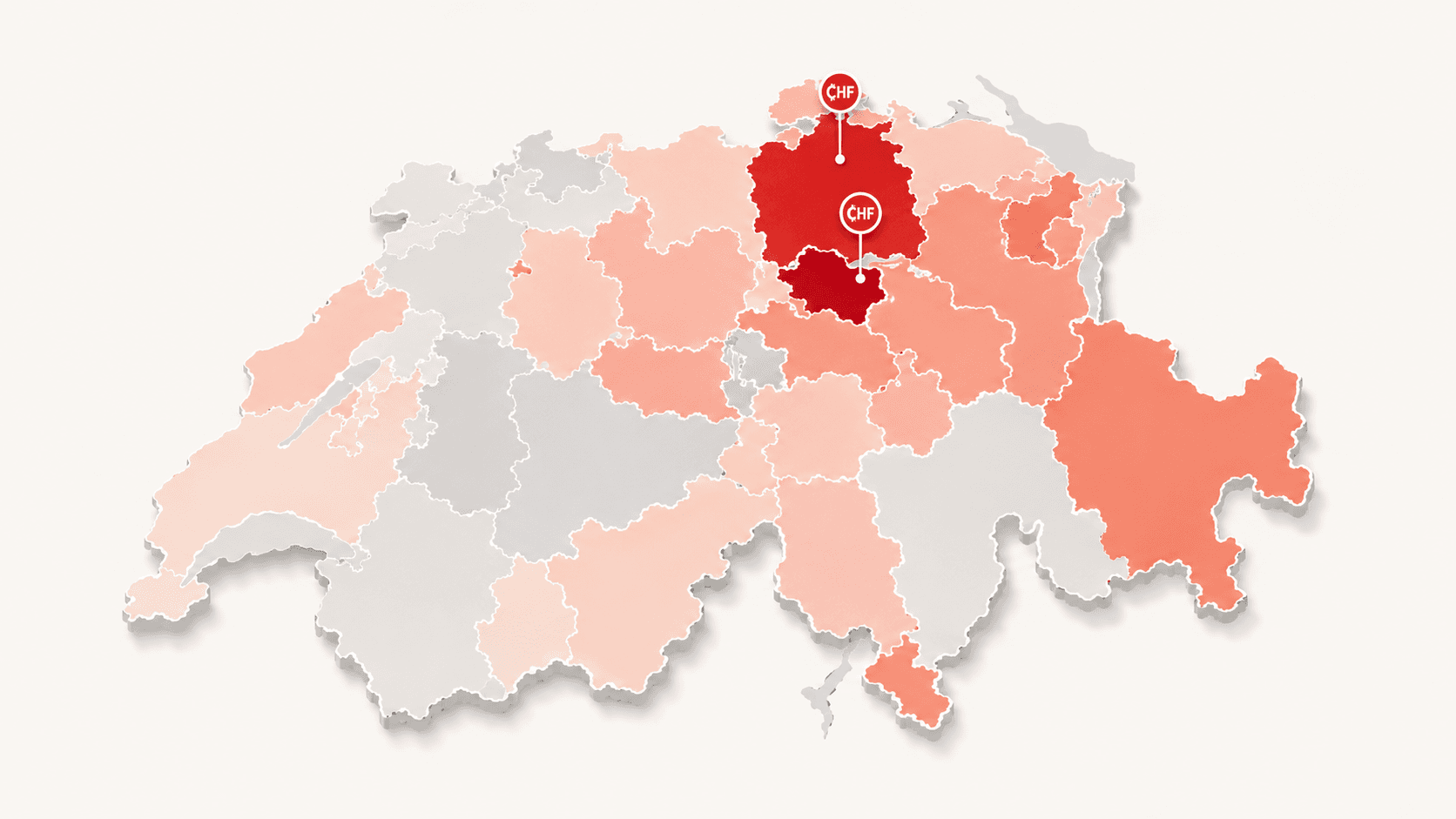
The average salary in Switzerland varies by up to CHF 40,000 per year depending on which canton you work in. This guide compares all 26 cantons, from Zurich and Zug at the top to rural Appenzell at the other end, with gross salary benchmarks, tax impact, and the finance role data you need to negotiate with confidence.
· 10 min read
In this guide
- Why canton matters more than you think
- Average salary: all 26 cantons ranked
- Major canton deep-dive: salary index & tax
- Finance roles: salary ranges by canton
- Zug spotlight: finance & multinationals
- Bonus structures at Swiss multinationals
- Gross to net: the tax impact by canton
- Where to benchmark your salary
- FAQ
1. Why canton matters more than you think
Switzerland has no national income tax rate. What you pay depends on three layers: federal tax (fixed for all), cantonal tax (varies widely), and communal tax (a multiplier on top of the cantonal rate). The result is that two employees with identical gross salaries, doing the same job at the same company, can have a CHF 15,000–40,000 difference in net annual take-home pay simply because they live in different cantons.
Beyond tax, canton of employment shapes your salary negotiation because it determines the labour market you are in. Zug is dominated by commodity trading and international holding companies. Basel-Stadt is pharma. Geneva splits between international organisations and private banking. Zurich is financial services, insurance, consulting, and tech. Each ecosystem has its own compensation benchmark.
2. Average salary: all 26 cantons ranked
The table below shows the estimated average gross annual salary for a mid-level professional (5–8 years experience) across all 26 Swiss cantons, covering all private-sector industries combined. These are LivingEase editorial estimates, not a licensed salary survey. They are built from the Federal Statistical Office wage structure survey (the only public, authoritative Swiss wage dataset) together with publicly advertised salary ranges in Swiss job postings. Treat them as orientation, and benchmark against a real survey before you negotiate: the sources to use are listed at the end of this guide. All figures are in CHF gross per year.
| Rank | Canton | Avg. gross salary (mid-level) | Dominant sectors | Tax tier |
|---|---|---|---|---|
| 1 | Zug (ZG) | CHF 125,000–145,000 | Commodities, multinationals, fintech | Very low |
| 2 | Zurich (ZH) | CHF 115,000–135,000 | Finance, tech, consulting, insurance | Moderate |
| 3 | Geneva (GE) | CHF 110,000–135,000 | Int'l orgs, private banking, luxury | High |
| 4 | Basel-Stadt (BS) | CHF 105,000–130,000 | Pharma, life sciences, chemicals | Moderate |
| 5 | Schwyz (SZ) | CHF 100,000–120,000 | Finance, holding companies | Very low |
| 6 | Nidwalden (NW) | CHF 95,000–115,000 | Manufacturing, finance | Very low |
| 7 | Obwalden (OW) | CHF 90,000–110,000 | Manufacturing, tourism | Low |
| 8 | Vaud (VD) | CHF 90,000–115,000 | MedTech, FMCG, hospitality mgmt | Moderate-high |
| 9 | Bern (BE) | CHF 88,000–110,000 | Government, healthcare, education | High |
| 10 | Aargau (AG) | CHF 85,000–108,000 | Manufacturing, energy, services | Moderate |
| 11 | Lucerne (LU) | CHF 85,000–107,000 | Services, healthcare, tourism | Moderate |
| 12 | Thurgau (TG) | CHF 82,000–105,000 | Manufacturing, agriculture | Moderate |
| 13 | St. Gallen (SG) | CHF 82,000–105,000 | Textiles, manufacturing, services | Moderate |
| 14 | Schaffhausen (SH) | CHF 82,000–103,000 | Manufacturing, chemicals | Moderate |
| 15 | Ticino (TI) | CHF 80,000–100,000 | Cross-border work, tourism, trade | Moderate |
| 16 | Neuchâtel (NE) | CHF 80,000–100,000 | Watchmaking, MedTech | Low-moderate |
| 17 | Solothurn (SO) | CHF 78,000–98,000 | Watchmaking, manufacturing | Moderate |
| 18 | Fribourg (FR) | CHF 78,000–97,000 | Food industry, services, admin | Moderate |
| 19 | Basel-Landschaft (BL) | CHF 78,000–98,000 | Pharma spillover, manufacturing | Moderate |
| 20 | Zug spillover (ZG rural) | CHF 78,000–95,000 | SMEs, logistics | Low |
| 21 | Graubünden (GR) | CHF 75,000–95,000 | Tourism, construction, agriculture | Low-moderate |
| 22 | Valais / Wallis (VS) | CHF 72,000–92,000 | Tourism, agriculture, energy | Low |
| 23 | Glarus (GL) | CHF 70,000–88,000 | Manufacturing, textiles | Moderate-high |
| 24 | Uri (UR) | CHF 68,000–86,000 | Construction, public sector | Low |
| 25 | Appenzell Ausserrhoden (AR) | CHF 67,000–85,000 | Manufacturing, services | Moderate |
| 26 | Appenzell Innerrhoden (AI) | CHF 65,000–82,000 | Agriculture, small manufacturing | Moderate-high |
3. Major canton deep-dive: salary index & tax
The table below shows relative salary levels across major cantons for private sector professional roles (manager to director level), indexed to Zurich = 100. It also shows the approximate effective income tax rate on a CHF 150,000 gross salary (single, no children) and the dominant industries driving local comp.
| Canton | Salary index | Eff. tax rate (CHF 150k gross) | Net take-home (approx.) | Dominant industries |
|---|---|---|---|---|
| Zug | 98–105 | ~20–22% | ~CHF 117,000–120,000 | Commodity trading, multinationals, holding cos |
| Zurich | 100 (index base) | ~28–30% | ~CHF 105,000–108,000 | Banking, insurance, consulting, tech |
| Basel-Stadt | 95–98 | ~26–28% | ~CHF 108,000–111,000 | Pharma, life sciences, chemicals |
| Geneva | 100–108 (intl. orgs higher) | ~32–36% | ~CHF 96,000–102,000 | Int’l organisations, private banking, luxury |
| Vaud (Lausanne) | 90–95 | ~30–33% | ~CHF 100,500–105,000 | MedTech, FMCG HQs, hospitality mgmt |
| Bern | 85–90 | ~30–33% | ~CHF 100,500–105,000 | Federal admin, healthcare, education |
| Ticino | 78–85 | ~27–30% | ~CHF 105,000–108,000 | Cross-border work, manufacturing, tourism |
4. Finance roles: salary ranges by canton
The table below covers four core finance roles across five major cantons. Ranges reflect the 25th to 75th percentile for professionals with 5+ years of experience, working at private sector companies with 500+ employees. These are LivingEase editorial estimates, not a licensed salary survey. They are built from the Federal Statistical Office wage structure survey (the only public, authoritative Swiss wage dataset) together with publicly advertised salary ranges in Swiss job postings. Treat them as orientation, and benchmark against a real survey before you negotiate: the sources to use are listed at the end of this guide.
| Role | Zurich | Zug | Geneva | Basel-Stadt | Bern |
|---|---|---|---|---|---|
| Financial Controller | CHF 120–165k | CHF 130–175k | CHF 125–170k | CHF 120–160k | CHF 100–140k |
| FP&A Manager | CHF 115–155k | CHF 125–165k | CHF 120–160k | CHF 115–152k | CHF 95–130k |
| Finance Director / VP Finance | CHF 180–260k | CHF 190–280k | CHF 185–270k | CHF 175–250k | CHF 150–210k |
| CFO (mid-size co.) | CHF 250–400k+ | CHF 270–450k+ | CHF 260–420k+ | CHF 240–380k+ | CHF 200–300k |
| Treasury Analyst / Manager | CHF 100–145k | CHF 110–155k | CHF 105–150k | CHF 100–140k | CHF 85–118k |
Preparing for a finance interview in Switzerland?
LivingEase optimises your CV for the Swiss finance job market: ATS formatting, Swiss hiring culture, and the right keywords for controller and FP&A roles.
Optimise my CV →5. Zug spotlight: finance & multinationals
Zug is home to more multinational company headquarters per capita than any other Swiss canton. Glencore (commodities), Johnson & Johnson Switzerland, Siemens Energy Switzerland, Landis+Gyr, and dozens of commodity trading firms are all based here. This concentration of large, profitable companies with global pay benchmarks drives compensation materially above the Swiss average.
For finance professionals, Zug is arguably the best canton in Switzerland. The combination of high gross compensation at multinationals and Switzerland’s lowest cantonal tax rate (Zug has held this position consistently for over two decades) creates unmatched net take-home at senior levels.
- Base salary range: CHF 130,000 – 175,000 (multinational environment)
- Senior / Director level: CHF 180,000 – 220,000
- Annual bonus (manager): 10–20% of base (target); up to 25% on over-performance
- Annual bonus (director): 20–30% of base; LTI may add 15–25% on top
- Effective tax rate (CHF 150k, Zug city): ~20–22%
- Net take-home on CHF 150k: approximately CHF 117,000–120,000/year
When negotiating a financial controller role in Zug, your anchor should be CHF 140,000–150,000 for 5+ years of experience in a relevant industry. If the company has a structured grade system (common at Glencore, J&J-type multinationals), ask for the grade band and what the top of band looks like before anchoring on a number. See our full guide on salary negotiation in Switzerland.
6. Bonus structures at Swiss multinationals
Swiss multinationals follow structured compensation frameworks with annual cash bonuses, and at senior levels, long-term incentive plans (LTIs) such as restricted stock units (RSUs), performance share units (PSUs), or phantom stock. Understanding the full package, not just base salary, is critical in any negotiation.
Annual cash bonus by level
| Level | Typical bonus target | Max (over-performance) | Common structure |
|---|---|---|---|
| Individual contributor (IC) | 5–10% of base | 10–15% | Annual, discretionary or formula-based |
| Manager / Senior Manager | 10–20% of base | 20–30% | Company performance + individual rating |
| Director / Senior Director | 20–30% of base | 30–45% | Formula-based; often includes LTI vest |
| VP / C-Suite | 30–60% of base | 60–100%+ | STI + LTI; board-approved; 3-year vest |
LTI (long-term incentive) norms
At large Swiss multinationals (Nestlé, Novartis, Roche, ABB, Zurich Insurance, Swiss Re), LTI programmes typically vest over 3 years and are awarded as a percentage of base salary. Director-level roles commonly receive an annual LTI grant worth 25–50% of base. VP and above often receive 50–100%+ of base in LTI. At commodity trading companies (Glencore, Vitol, Trafigura), the variable component is far higher and can dwarf the base salary.
7. Gross to net: the tax impact by canton
The table below shows approximate net annual take-home pay for a single professional with no children at three gross salary levels, across the major cantons. Figures are estimates based on cantonal + communal tax rates for the canton capital (e.g., Zurich city, Geneva city, Zug city, Basel city, Bern city). Social security deductions (AHV/IV/ALV: ~6.35% of gross) are included in all calculations.
| Canton | Net on CHF 100k gross | Net on CHF 150k gross | Net on CHF 200k gross |
|---|---|---|---|
| Zug | ~CHF 82,000 | ~CHF 118,000 | ~CHF 153,000 |
| Zurich | ~CHF 76,000 | ~CHF 106,000 | ~CHF 137,000 |
| Basel-Stadt | ~CHF 77,000 | ~CHF 109,000 | ~CHF 140,000 |
| Vaud (Lausanne) | ~CHF 74,000 | ~CHF 103,000 | ~CHF 132,000 |
| Bern | ~CHF 73,000 | ~CHF 102,000 | ~CHF 130,000 |
| Geneva | ~CHF 72,000 | ~CHF 99,000 | ~CHF 126,000 |
At CHF 200,000 gross, Zug produces approximately CHF 27,000 more net per year than Geneva. Over a 5-year period, that is over CHF 135,000 in additional take-home pay, equivalent to nearly a full year’s additional salary.
Moving to Zug, Zurich, or Basel for a new role?
Before you sign your lease, let LivingEase translate your Swiss rental contract clause by clause, in plain English, with tenant rights flagged automatically.
Translate my lease →8. Where to benchmark your salary
Self-reported salary data is noisy: here are the most reliable sources for Switzerland, ranked by quality:
- Swiss Federal Statistics Office, LSE (Lohnstrukturerhebung): The official biennial wage survey covering 1.6 million employees. Free, by industry, occupation, and canton. Most authoritative but published every two years. Latest data is 2024. bfs.admin.ch.
- Mercer Switzerland Total Remuneration Survey: The gold standard for multinational benchmarking. Expensive to access directly, but your HR department likely uses it. Ask your recruiter which survey the company references for the grade band.
- Michael Page / Robert Half Switzerland Salary Guides: Free annual salary guides by function and level. Less precise than Mercer but publicly available and updated yearly. Good for ballpark positioning.
- LinkedIn Salary Insights: Useful for real-time triangulation by job title, company size, and location. Filter by Switzerland + canton for best results.
- Glassdoor CH / kununu.com: Self-reported data, useful for company-specific ranges but treat with a 15–20% margin of error. Best used to validate, not anchor.
FAQ
Which Swiss canton has the highest salaries?
Zurich ranks highest for absolute gross salaries in the private sector due to the density of financial services, consulting, and tech firms. Zug offers comparable or higher gross pay in finance and commodity trading, combined with the lowest effective tax rates in Switzerland, making it the top canton for net take-home at senior levels.
What is the average salary for a Financial Controller in Zug?
A Financial Controller at a multinational company in Zug typically earns CHF 130,000–175,000 gross per year. Senior controllers or directors can reach CHF 180,000–220,000. Annual bonuses at multinationals in Zug range from 10–20% of base at manager level, and 25–30% at director level.
How much does canton affect take-home pay?
Significantly. On CHF 150,000 gross, the effective tax rate ranges from ~20–22% in Zug to ~32–36% in Geneva. This creates a CHF 15,000–20,000 difference in annual net take-home for the same gross salary. Over a 5-year period, choosing the right canton can be worth more than a single year’s salary.
What bonus structures are typical at Swiss multinationals?
Annual cash bonuses range from 5–10% for individual contributors, 10–20% for managers, and 20–35% for directors. C-suite roles add long-term incentive plans (LTIs) worth 30–60% of base. Companies like Nestlé, Novartis, Roche, ABB, and Zurich Insurance follow structured global bonus frameworks.
Is the salary in Geneva higher than in Zurich?
Gross salaries in Geneva are 5–10% higher for international organisation roles (UN, WHO, WTO) and comparable for private sector finance. However, Geneva’s higher cantonal tax and housing costs often erode the gross advantage. For private sector roles, Zurich generally offers better net purchasing power.
Should I negotiate salary based on which canton I will live in?
Yes. If you are moving to a low-tax canton like Zug or Schwyz, your net purchasing power is materially higher than in Geneva or Bern at the same gross. If offered a role in Geneva, use the tax differential as a negotiation argument to push the gross higher. Always run a gross-to-net simulation first.
Your Swiss relocation, handled
CV optimisation · Lease translation · Salary guides · Tenant rights. LivingEase gives you the full toolkit to land and settle in Switzerland with confidence.
Optimise my CV →Related guides
Keep reading